TLDR: A wind-down routine works only if you actually do it. Long elaborate routines fail because they require a perfect day. A five-minute ritual built on three tiny habits — dim the lights, slow the breath, let go of one thing — is short enough to do on the worst nights and powerful enough to compound.
Most evening routine advice fails for the same reason: it assumes you have an hour, a clean bedroom, and a peaceful mind to start with.
The internet's wellness corner is full of 60-minute "wind-down stacks" — bath, journal, gratitude list, herbal tea, stretches, meditation, gua sha, ambient music, sleep mask, hourly screen detox. By the time you've read the list, it's 11:47pm and you're more stressed than when you started.
Here's the truth no one says out loud: the best wind-down routine is the one you'll do on your worst night. Not your best night. The night you got home at 10:40, the inbox is on fire, and you're eating cereal standing up.
That routine has to be short. Like, embarrassingly short. Five minutes. Three things. That's it.
Why Five Minutes Beats Fifty
Behavior research has been consistent on this for decades: habit consistency matters more than habit duration. A daily 5-minute practice you actually do beats a 50-minute one you do once a fortnight, every single time.
This is especially true for the nervous system. The parasympathetic shift (the body's "rest and digest" switch) responds to repetition. Same cues, same time, same sequence. Your body starts to recognize the pattern: oh, we do this now, and then we settle.
An hour-long elaborate routine almost guarantees inconsistency. A five-minute one almost guarantees compliance.
Start where you'll actually finish.

The Three Habits
The five minutes break down into three roughly equal pieces. Each one is doing a specific job for your nervous system.
Habit 1: Dim the Light (90 seconds)
The single biggest evening intervention you can make for free is reducing light intensity in the 30-60 minutes before bed. Light is the strongest signal your circadian system reads. Bright overhead light at 10pm tells your brain it's still midday.
What this looks like:
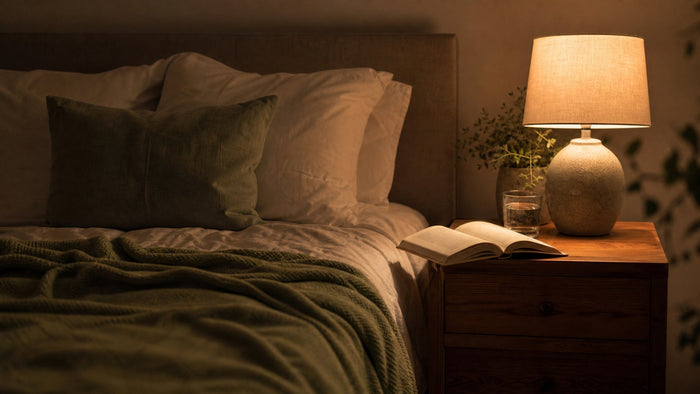
- Overhead lights off. Lamps only.
- If you can, switch lamps to warm bulbs (2700K or lower).
- Phone brightness all the way down. Better yet, phone in another room.
- If the bathroom has a bright vanity bulb, brush your teeth in lower light if you can.
That's the whole habit. Lower the lumens. Your body interprets it as: nightfall is happening, time to settle.
Habit 2: Slow the Breath (2 minutes)
Slow breathing — specifically longer exhales than inhales — is the most direct manual override of the autonomic nervous system that exists. It's free. It works in under two minutes. And almost no one does it consistently.
The simplest version, sometimes called 4-6 breathing:
- Sit or lie down. Hands wherever's comfortable.
- Inhale through the nose for 4 seconds.
- Exhale through the nose (or pursed lips) for 6 seconds.
- Repeat for 2 minutes. That's about 12 breath cycles.
The longer exhale is the key. It's what activates the vagus nerve and triggers parasympathetic dominance. You don't need to be perfect at counting. You don't need to be in lotus pose. You just need the exhale to be longer than the inhale.
If you forget everything else in this article, remember this: the long, slow exhale is the off-switch your nervous system was looking for.
Habit 3: Let One Thing Go (1.5 minutes)
This is the cognitive piece. Most evening anxiety isn't about the day that just ended — it's about the day that hasn't started yet. The to-do list. The email you forgot. The conversation you owe someone.
The habit: name one thing you're carrying, and explicitly set it down until morning.
You can do this on paper, in your head, or out loud. The version that works best for most people is writing it down:
- Keep a small notebook by the bed.
- Write one sentence: "I'm carrying ___. I'll pick it up tomorrow at ___."
- Close the notebook. Done.
This isn't a productivity hack. It's a permission slip. You're telling your brain explicitly: I know this matters, I've noted it, you can stop circling it now. The default mode network — the brain network responsible for rumination — needs that permission. It won't release a thought it thinks you'll forget.

Putting It Together
The full five-minute version, on autopilot:
- Walk into the bedroom. Overhead light off, one lamp on. 90 seconds.
- Sit on the edge of the bed. Twelve slow breaths, exhale longer than inhale. 2 minutes.
- Open the bedside notebook. Write one sentence. Close it. 1.5 minutes.
Five minutes. No app required. No subscription. No new equipment.
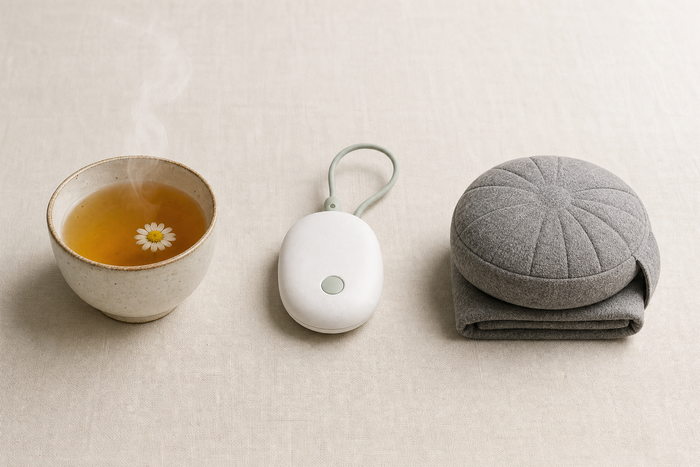
If you want to layer in one more signal, that's where a Calmiora Core session fits naturally — either during the breath work or right after, while you're already settled. A few minutes of gentle microcurrent input in parallel with slow breathing gives the nervous system two safety cues at once. But the ritual works without it. The ritual is the foundation; the device is the assist.
What to Do When You "Forget"
You will forget. Most nights at first, then occasional nights, then rarely. That's how every habit goes.
When you forget, the rule is simple: do the shortened version in bed. Twelve slow breaths is the minimum viable ritual. You can do that in the dark, under the covers, three minutes before falling asleep. It still works.
The point is never perfection. The point is showing up — short, repeatable, sustainable — for long enough that your body learns the pattern.
Frequently Asked Questions
Does this work if I can't fall asleep?
This routine isn't designed to make you fall asleep — it's designed to help your nervous system shift from "alert" to "settled." That shift makes natural rest more likely, but if you have ongoing trouble winding down despite a consistent routine, that's worth talking to a healthcare provider about.
What if I don't have a bedside notebook?
The notes app on your phone works, but it's a worse option because it pulls you back into your screen. Anything physical — a notepad, a scrap of paper, the back of a receipt — works better. The act of writing by hand is part of what releases the thought.
How long until this starts working?
Most people notice their nervous system shifting faster — sometimes within the first session of slow breathing. The cumulative effect (where the routine starts to feel automatic and easier to do) usually takes 2-3 weeks of mostly-consistent practice.
Can I do this in a different order?
Yes, but the order matters for your body. Light first reduces stimulation. Breath second drops the heart rate. Cognitive release last, when the body is already calmer, is when your brain can actually let go of the thought. Reversing the order tends to make the cognitive release less effective.
What if my partner has the lights on and is on their phone?
This comes up a lot. Two options that work: (1) do the ritual in another room (bathroom counts), or (2) use a soft sleep mask for the light piece and headphones with a quiet ambient track to insulate. The ritual still works in a non-ideal environment — it just needs you to do it.
Five minutes. Three small habits. Done on the bad nights, not just the good ones.
That's the routine that actually changes things. Not the one that looks impressive on a Sunday-night Instagram reel. The one you'll still be doing in March.
Disclaimer: Calmiora products are consumer wellness electronics, not medical devices. They are not intended to diagnose, treat, cure, or prevent any disease, and have not been evaluated by the FDA. If you have a heart condition, an implanted medical device, a seizure disorder, or are pregnant, please consult your healthcare provider before use. Individual experiences may vary.