TLDR: Most evening routine advice assumes you have an hour, a quiet house, no responsibilities after 8pm, and the energy to follow a 12-step plan. If your evening looks nothing like that, you need a routine designed for the actual conditions of a full life — short, portable, and possible on the chaotic nights. Here's that routine.
You finally sit down at 10:34pm. The dishwasher is running. There's a half-folded pile of laundry on a chair. A text you forgot to answer is open on your phone. Tomorrow starts at 6:15am, and you are, on paper, supposed to spend the next hour doing a calming wind-down ritual involving herbal tea, a gratitude journal, gentle stretches, and warm lighting.
Yeah, no.
This article is for the version of evening that actually exists — the one with kids, with deadlines, with second jobs, with elderly parents, with travel weeks, with the dog who needs walking right when you finally feel calm. It's also for the version where there's no one else to blame: you just scrolled for forty minutes and now it's late and you're tired.
Either way, you don't have an hour. You probably don't have twenty minutes. You might have ten — and ten is enough.
The Real Rules
Before the routine itself, three rules that change everything.
Rule 1: Lower the bar relentlessly
The wind-down that gets done beats the wind-down that gets postponed every single time. If your routine requires a quiet space, a specific tea, perfect lighting, and uninterrupted attention, you've designed something that will fail two nights out of three.
Aim for a version you could do standing in a hotel bathroom with the door locked while your kid bangs on the other side. That's the version that will actually work for the next year of your life.
Rule 2: Make it portable
You won't always be home. You'll be at a parent's place, on a work trip, on a couch at a friend's, in an airport. The routine has to travel. If it depends on a specific blanket, a specific lamp, a specific app, or a specific room, it'll collapse the moment your life moves.
Anything you genuinely need should fit in your everyday bag.
Rule 3: Decouple from sleep
This is the hidden one. People design wind-down routines as a path to falling asleep, which means the routine "fails" any night they don't fall asleep quickly. That framing kills consistency.
Reframe: the routine is just a 10-minute interruption from the day, not a sleep treatment. You're not trying to fall asleep at the end of it. You're trying to switch states. Whether sleep follows is a separate variable.

The 10-Minute Version
This routine has four pieces, totaling around ten minutes, and you can scale it down to three minutes when you need to.
1. Lights down (30 seconds)
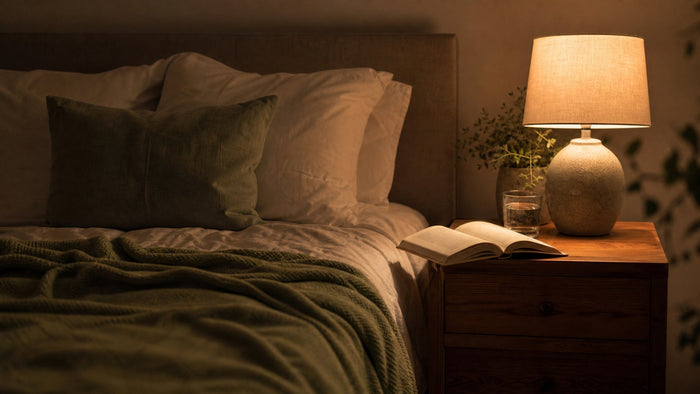
Walk through wherever you're going to be for the next ten minutes — bedroom, bathroom, couch — and kill the overhead lights. One lamp on if you need light. Phone brightness all the way down, or face-down on a surface where you can't see it.
That's it. 30 seconds.
2. Body check (2 minutes)
Sit or lie down. Do a fast top-to-bottom scan of your body: jaw, shoulders, hands, stomach, hips, legs. Where are you holding tension you didn't know about? Soften that spot. Move on.
Don't be precious about this. You're not meditating. You're just unclenching whatever has been clenched for the last six hours.
3. Slow breath (3 minutes)
This is the heart of the whole routine. If you only do this part, you'll still get most of the benefit.
Twelve to eighteen slow breaths. Inhale 4 seconds through the nose. Exhale 6 seconds through pursed lips or nose. The longer exhale is what flips your nervous system toward "settled."
Don't count perfectly. Don't strive. If you lose track, just keep breathing slowly with a longer exhale. That's the whole point.
4. Permission slip (90 seconds)
Open whatever you write in — physical notebook, notes app on your phone, back of a receipt. Write one sentence:
"I'm carrying [the thing]. I'll pick it up tomorrow at [time/place]."
You're not solving anything. You're just signaling to your brain that the thing has been registered and assigned a future moment. The brain stops re-surfacing it once it trusts that you'll come back.
5. (Optional) A few minutes of microcurrent (5-10 minutes)
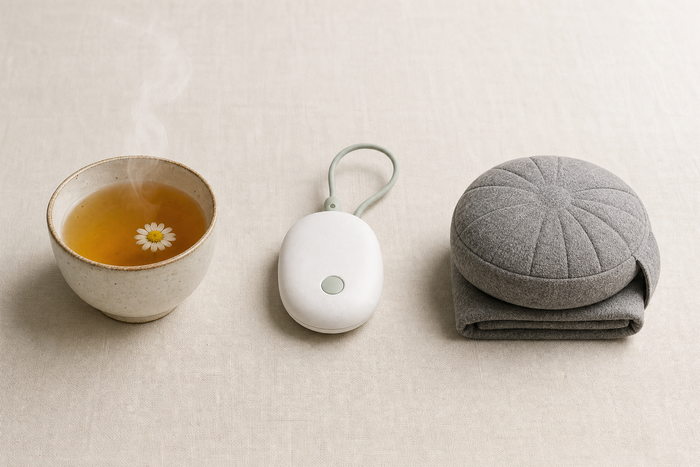
If you've added a Calmiora Wave or Core to the routine, this is where it fits. Use it during the breath work or right after, while you're already settled. It runs in the background — no extra effort, no extra time. The portable form factor of Wave is specifically designed for this kind of in-bed, in-hotel-room, in-anywhere use.
The 3-Minute Emergency Version
For the nights it really is 11:53pm and you've got nothing left:
- Lights off. (10 seconds.)
- Twelve slow breaths in bed. Exhale longer than inhale. (2 minutes.)
- One sentence in the phone's notes app: "Tomorrow, [the thing], [time]." (30 seconds.)
Three minutes. In bed. Eyes closed. Done.
This isn't a "weakened" version of the routine. On the bad nights, this is the routine. Doing this on chaotic nights instead of skipping entirely is what builds the habit. Consistency beats elaborateness.

What to Build the Routine Around
The single most useful design move is attaching the routine to something you already do every night. Don't try to add a new 10-minute block to your evening — graft the routine onto an existing one.
Some pairings that work for busy people:
- After brushing teeth — you're already in the bathroom, lights are about to go off anyway.
- After putting kids down — you've earned the sit-down, your body is already softening from "in charge" mode.
- While the partner showers — the room is dim, you have three uninterrupted minutes.
- On the couch right before bed — instead of opening one more app, you do the breath round.
Pick one anchor. Just one. The routine should slot into a moment that's already happening.
What Doesn't Work for Busy People
For the sake of clarity, some advice that doesn't hold up under real-life conditions:
- "Stop using screens an hour before bed." A nice idea, but for many adults with work that bleeds into evenings, this isn't feasible. Dimming brightness and switching to less-stimulating content matters more than the absolute hour rule.
- "Go to bed at the same time every night." Aspirational. For most working adults, the variable isn't really controllable. Aim for a consistent wind-down cue, not a consistent bedtime.
- Hour-long elaborate evening rituals. These are great if your life supports them. Most don't. Don't feel bad if Instagram's nightly routines look nothing like yours.
Frequently Asked Questions
What if I genuinely don't have ten minutes?
Do the 3-minute emergency version. Twelve slow breaths with longer exhales is the minimum effective dose. You can do that lying in bed with your eyes closed three minutes before you fall asleep. It still works.
Can I do this routine in bed instead of getting up?
Yes. The lights-down and the breath work can happen in bed. The "permission slip" works with your phone's notes app held above your face (just turn brightness down to minimum). The portable version is the point.
What about when I'm traveling?
This routine is specifically designed for travel. None of it requires anything bigger than a phone. If you've added a Calmiora device, Wave is the portable option — the Core stays at home for some users, Wave goes in the bag.
Will my partner think I'm being weird?
Probably not, but if it matters: most of this routine looks like "lying still with your eyes closed for a few minutes." That's not weird in any culture. If it helps, you can frame the breath work as just "trying to relax for a minute" — it's accurate, and it doesn't require explaining wind-down strategy to anyone.
How long does it take before this feels automatic?
Two to three weeks for the routine to feel like part of the evening rather than a new task. Six to eight weeks for the body to start anticipating the routine — at which point the parasympathetic shift starts happening earlier, sometimes before you've even started the breath work.
The wind-down that works isn't the elaborate one in the Pinterest-perfect bedroom. It's the short one you'll actually do on the night the dishwasher is running, the laundry isn't folded, and tomorrow starts in seven hours.
That routine. Done most nights. Imperfect. Portable. Three minutes when it has to be. That's the one that compounds.
Disclaimer: Calmiora products are consumer wellness electronics, not medical devices. They are not intended to diagnose, treat, cure, or prevent any disease, and have not been evaluated by the FDA. If you have a heart condition, an implanted medical device, a seizure disorder, or are pregnant, please consult your healthcare provider before use. Individual experiences may vary.