TLDR: Meditation, chamomile tea, and microcurrent devices all work — for different reasons, on different timelines, and with different trade-offs. The right one depends on your specific evening, your specific mind, and what you've already tried. Most people end up combining two of the three. Here's the honest comparison.
If you've ever Googled "how to calm down at night," you've seen three big recommendations come up over and over:
- Meditate
- Drink a calming tea
- Try a wellness device (microcurrent, vagal stimulation, the whole category)
Each one has its own tribe online. The meditation people think the tea people are lazy. The tea people think the device people are gadget-obsessed. The device people think the meditation people have too much free time. Everyone's a little bit right and a lot wrong.
So here's an honest, non-tribal comparison — what each one actually does, where it works, where it fails, and how to decide.
What Each One Actually Does
Meditation
Meditation, broadly defined, is the practice of placing attention deliberately. The most relevant form for evening wind-down is some variation of body scan, breath awareness, or mindfulness of present sensation.
What it does to your body: Trained meditation has been shown to shift autonomic balance toward the parasympathetic system, lower cortisol, reduce default mode network activity, and — over time — change how the brain processes emotional content.
How long it takes to work: Single sessions can produce a calming shift in 10-20 minutes. Cumulative effects (where evenings feel calmer overall) usually appear after 4-8 weeks of consistent daily practice.
What it costs: Free. An app subscription if you want guided sessions, but completely free as a practice.
Chamomile (and Other Calming Teas)
Chamomile is the most-studied "calming tea." Other contenders — lemon balm, passionflower, valerian — work through similar but distinct mechanisms.
What it does to your body: Chamomile contains compounds (notably apigenin) that bind to GABA receptors in the brain — the same general pathway that pharmaceutical sedatives like benzodiazepines use, just much, much more weakly. The effect is real but modest. It's also helped along by the ritual itself: warm cup, slow sipping, dim light, designated wind-down moment.
How long it takes to work: Subjective calm often within 15-30 minutes of finishing a cup. The effect is not dramatic — it's a soft nudge.
What it costs: A few dollars a month if you buy loose leaf or quality bagged tea.
Microcurrent Devices
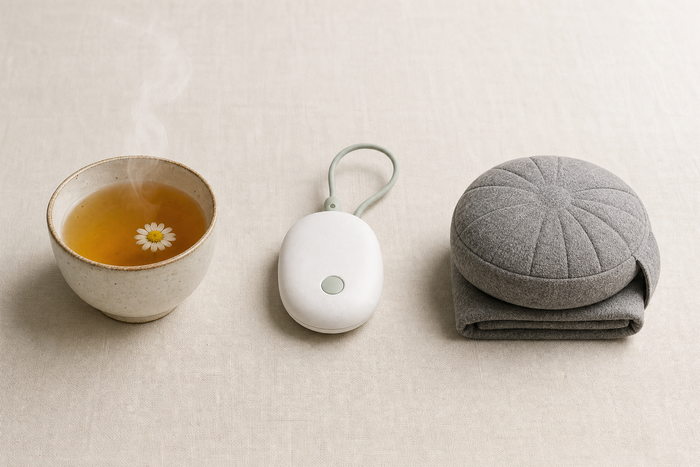
Microcurrent wellness devices like Calmiora Core deliver very low-level electrical pulses (in microamperes — millionths of an amp) through points on the skin. The body interprets this as a steady, gentle sensory input.
What it does to your body: Gives the nervous system a consistent rhythmic input to track, which the autonomic system tends to read as a safety signal. The effect overlaps with what slow rhythmic breath, weighted blankets, and steady soft sound also do — calming via consistent gentle input. Read more on how it works.
How long it takes to work: Many users notice a subjective shift within a single 10-20 minute session, though the effect is modest and additive. Cumulative effects appear over a few weeks of regular use.
What it costs: A one-time device purchase. Calmiora's Core is the entry-level option; Wave adds portability; Pulse adds rhythm variety.

Side-by-Side Trade-Offs
Here's where the differences get clearer — and where personal fit starts to matter.
Effort Required
- Meditation: High. Requires active attention, willingness to sit with the mind, and a learning curve.
- Chamomile: Very low. Boil water, steep, drink.
- Microcurrent: Low. Turn on, place on skin, do other things. Runs in the background.
Portability
- Meditation: Maximum — works anywhere, including in a hotel, on a plane, in bed.
- Chamomile: Medium — you need water, a cup, and time to brew.
- Microcurrent: Medium to high. Most devices are travel-friendly (Wave especially).
Speed of Effect
- Meditation: 10-20 minutes in a single session, but the meaningful long-term effects need weeks of consistency.
- Chamomile: 15-30 minutes after the cup is finished.
- Microcurrent: 10-20 minutes within a session, additive over weeks.
Risk and Side Effects
- Meditation: Generally none. Rarely, intense practice can surface difficult emotions for people with trauma histories — worth doing gradually if that applies.
- Chamomile: Possible drowsiness (which is the point), occasional mild interactions with certain medications, allergic reactions in some people with ragweed allergy.
- Microcurrent: Generally well-tolerated for healthy adults. Contraindicated for pacemakers, implanted medical devices, seizure disorders, pregnancy, active heart conditions.
Cost Over a Year
- Meditation: $0 to ~$100 (app subscription if used).
- Chamomile: $30-80, depending on quality and frequency.
- Microcurrent: Cost of the device, no recurring fees.
So Which One Should You Pick?
Honest answer: most people who get serious about wind-down end up using two of the three, and it's not always the same two.
Some rough heuristics:
If your mind is loud and won't quiet
Microcurrent or chamomile first, meditation second. A racing mind is hard to meditate through — it tends to amplify the racing. Settling the body first (via gentle input) makes it much easier to bring attention back to a calmer mind later. Many users find a Calmiora session works as the doorway into being able to meditate at all.
If you're skeptical of devices but open to ritual
Chamomile and meditation. They pair beautifully — the warm cup becomes the wind-down cue, the meditation deepens the effect, and there's nothing to plug in.
If you want something that doesn't require active mental work
Microcurrent. The point of microcurrent is that it works in the background while you read, breathe, or just lie there. You don't have to do anything to make it work. For people whose attention is depleted by the end of the day, this matters a lot.
If you have under five minutes
None of the three on their own does much in under five minutes. The thing that works in under five minutes is slow breathing — specifically, twelve breaths with a longer exhale. That single habit, free, doable in bed, is the foundation under everything else on this list.

The Stack Most People End Up With
For what it's worth, after talking to a lot of Calmiora users, the stack that emerges most often looks like:
- Slow breath as the base layer — always available, always free, the doorway to everything else.
- Either tea or microcurrent (rarely both at full intensity) as the "ritual layer" — the thing that signals "now I'm doing the wind-down."
- Meditation as an aspirational layer — used some nights, not others, and that's fine.
What you don't see in this list: any one tool used in isolation, expected to do everything. Anyone selling you that is overselling.
Why "Which Is Best" Is the Wrong Question
The reason this comparison gets tribal online is that everyone's evening is different. The meditator with a quiet apartment has a different problem than the parent of toddlers. The person dealing with chronic stress has a different problem than the person whose evenings are mostly fine but occasionally loud.
"Which works best?" is a worse question than: which one fits the specific shape of my evening, my body, and my mind, on most nights?
The answer to that is almost always personal. And it usually changes over time.
Frequently Asked Questions
Can I use microcurrent and chamomile at the same time?
Yes, with no known interaction. Many users sip a small cup of chamomile while running a microcurrent session — the two together form a calmer ritual than either one alone. Always check the product disclaimer for any specific contraindications.
Is meditation just always better because it's free?
For some people, yes. For many people, no. Meditation requires a level of attention and effort that depleted, busy people often don't have at 11pm. Tools that work in the background (like microcurrent or a tea ritual) often serve people who simply can't muster more attention by end of day. "Free" isn't the same as "accessible."
Doesn't chamomile work just as well as a device?
For some people, on some nights, absolutely. Chamomile is a real, gentle, GABA-modulating compound. It's also limited — it's hard to "increase the dose" without diminishing returns, and it only works during and shortly after drinking it. A wellness device adds a different kind of input. Many people use both for different reasons.
Will a microcurrent device replace my therapist or sleep medication?
No, and it shouldn't be expected to. Calmiora is a consumer wellness device, not a medical device, and isn't designed to treat any condition. If you're managing a clinical issue with professional help, keep doing that. Wellness tools are companions, not replacements.
What's the single most important habit if I can only build one?
Slow breathing with a longer exhale. Free, portable, works in any environment, takes two minutes, and is the foundation that every other tool here works alongside, not instead of.
Microcurrent isn't better than meditation. Meditation isn't better than chamomile. Chamomile isn't better than slow breath.
They're different tools that all do a small, useful thing. The right combination is the one you'll actually keep doing — most nights, most weeks, most months.
If you're starting fresh, start small. Slow breath tonight. Add a cup of tea or a Core session next week. Try a five-minute meditation when you're ready. Build the stack over months, not nights.
That's the routine that lasts.
Disclaimer: Calmiora products are consumer wellness electronics, not medical devices. They are not intended to diagnose, treat, cure, or prevent any disease, and have not been evaluated by the FDA. If you have a heart condition, an implanted medical device, a seizure disorder, or are pregnant, please consult your healthcare provider before use. Individual experiences may vary.