TLDR: Racing thoughts in the evening aren't a sign that something is wrong with you. They're a sign that your brain's default mode network — the network responsible for inward reflection — finally has bandwidth to surface unresolved thoughts now that the day's external demands have stopped. The loop is predictable, which means it's interruptible.
You had a fine day. Maybe even a good one. You weren't particularly stressed at lunch. You weren't worried at 5pm. You watched something light in the evening, brushed your teeth, got into bed.
And then, somewhere around 11:14pm, your brain pulled up an email from three weeks ago that you forgot to respond to, then connected it to a comment your boss made at the team meeting, then jumped to whether you should have gone to a different college, then circled back to whether the email could still be replied to without it being weird.
You're not anxious. You don't have anything specific to be anxious about. You're just thinking, very actively, about everything, all at once, and you can't make it stop.
This is one of the most common patterns in adult cognition, and it has a name.
The Default Mode Network
Your brain has a network — a constellation of regions that activate together — called the default mode network, or DMN. It's been one of the most studied features of human brain function over the last two decades.
The DMN turns on when you're not focused on an external task. Daydreaming, reminiscing, planning, mentally simulating future conversations, replaying past ones — that's the DMN at work.
This is, in normal amounts, a useful network. It's where most creative insight happens. It's how you mentally rehearse situations. It's part of how identity, memory, and meaning all get woven together.
But in the evening — when external task demand drops to near zero — the DMN doesn't get a memo that you're "done for the day." It keeps doing what it does best: surfacing unresolved material from the back of your mind and asking you to look at it.
If you've ever wondered why you can't think of anything important during a meeting but you can think of seventeen important things at 11pm, this is why. The DMN doesn't time-share with your task brain. It waits for an opening.

Why the Loop Feels Endless
Once the DMN is active in the evening, three things usually compound:
1. There's no external input to interrupt it
During the day, every email, conversation, or task switch gives your brain something else to look at. At night, with the lights off and the room quiet, there's nothing competing. The thoughts get the whole stage.
2. The body is alert
For many adults experiencing chronic low-grade stress, cortisol stays elevated later than it should. Combined with a brain that's still working, the body interprets the situation as: we shouldn't be resting yet — something must still need our attention. The looping intensifies.
3. Trying to stop the loop makes it stronger
This is the cruel part. Telling yourself "stop thinking" is essentially asking your brain to focus on the very thing you want it to drop. The thought re-energizes every time you try to push it away. This is well-documented in cognitive psychology — it's called ironic process theory, and it's why "just relax" is the worst possible advice.
What Actually Works (And Why)
You can't stop a thought loop. You can redirect one.
The DMN quiets down when something else becomes more interesting to the brain. It doesn't have to be exciting. It just has to be sensory and present — something happening in your body, in this moment, that's mild enough to feel safe but distinct enough to hold attention.
Things that work reliably:
- Body-focused attention. Slowly noticing physical sensations — the weight of the blanket, the temperature of your skin, the texture of the pillow under your hand. This gives the brain a real-time sensory feed to track, and the DMN naturally dims.
- Slow breathing with a longer exhale. The breath is internal sensory input, and the longer-exhale rhythm doubles as a parasympathetic activator. Two things at once.
- Gentle rhythmic input from the outside. Soft consistent sound (rain, a fan), a hand resting somewhere warm, or a low-level steady signal like gentle microcurrent. The body picks up the rhythm and the brain has something steady to track.
None of these "stop" the thoughts. They give the brain a more interesting place to focus. The thoughts soften from there.

The Permission Slip Trick
One technique deserves its own mention because it works disproportionately well for cognitive looping.
If a specific thought keeps coming back — the email, the conversation, the worry about tomorrow — your brain is essentially asking: are you going to forget this?
The fix is to give it a written answer.
Keep a small notebook by the bed. When a thought keeps returning, write one sentence:
"I'm carrying [the thing]. I'll pick it up tomorrow at [time / place]."
That's it. Close the notebook. The DMN often releases the thought once it has confirmation that you've registered it and assigned it a future moment. You're not solving it — you're just promising you'll come back to it. That promise is usually enough.
When Calmiora Fits In
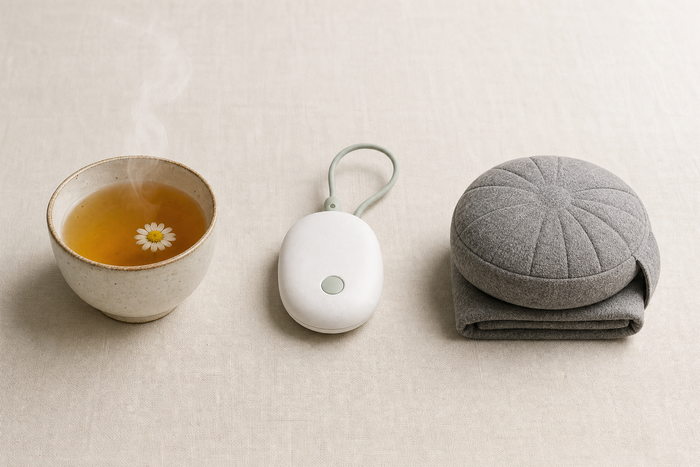
Microcurrent devices like Core work as part of this picture in a specific way: they give the body something steady to feel. Not loud. Not dramatic. Just consistent enough that your nervous system has a quiet rhythm to track instead of cycling through the back catalogue of every awkward moment from 2017.
This is the opposite of how people sometimes imagine the device working. It's not "zapping" you out of overthinking. It's giving you a gentler thing to pay attention to. The brain shifts because something is more present and more interesting than the loop.
Like everything else here, it's a small input that compounds. It works best alongside dim light, slow breathing, and the willingness to let the loop happen without arguing with it.
What If the Loop Doesn't Stop?
Some nights it won't. That's normal. Even the most steady wind-down practice doesn't quiet every thought spiral, and trying to demand silence from a busy mind is part of what keeps it noisy.
On those nights, the rule is: stop trying to stop. Let the thoughts run. Stay in bed, in the dark, with your eyes closed. Don't scroll. Don't turn on the light. Don't argue with the loop.
You'll often find that once you stop resisting, the noise drops on its own within 15-30 minutes. Even if it doesn't, rest with eyes closed in the dark still has meaningful recovery value — you don't have to "succeed at sleeping" for the night to count.
If racing thoughts at night persist for weeks despite a consistent wind-down practice, that's worth a conversation with a healthcare provider. Persistent insomnia and anxiety are real, treatable issues, and a wellness routine isn't a substitute for clinical care when one is needed.
Frequently Asked Questions
Why do I think about embarrassing things from years ago at night?
The default mode network surfaces emotionally unresolved material when external task demand drops. Embarrassing memories often haven't been fully processed, so they keep getting flagged for review. It doesn't mean something is wrong with you — it means your brain is doing exactly what it's designed to do, just at an inconvenient time.
Why does it always happen right when I'm trying to sleep?
Sleep is the moment external stimulation drops to its lowest level all day, which is precisely when the default mode network has the most bandwidth. There's nothing else competing for your attention, so the inward-facing thoughts get the floor.
Does writing things down really work?
For most people, yes, surprisingly well. The act of writing seems to signal the brain that the thought has been "registered" and doesn't need to keep being re-surfaced. The notebook becomes a trusted external memory, and the brain stops feeling responsible for holding onto the thought.
Is overthinking at night a sign of anxiety?
Not necessarily. Occasional evening rumination is extremely common in adults without any diagnosable anxiety. However, if the racing thoughts are persistent, severe, accompanied by physical symptoms like panic, or significantly disrupting your rest for more than a few weeks, that's worth bringing to a healthcare provider.
Can Calmiora stop racing thoughts?
No, and any device that claims to "stop" thoughts is overselling. What gentle microcurrent can do is give your nervous system a steady, low-level input to track, which often makes it easier to settle alongside the rest of your wind-down routine. It's a small assist, not an off switch.
Racing thoughts in the evening aren't a sign you're broken. They're a sign your brain is doing what brains do, on a schedule that doesn't suit you. You can't shut it off. You can give it gentler things to track, and you can give yourself permission to stop fighting the loop.
That's the work. Quiet, repeatable, small. Done on the bad nights, not just the good ones.
Disclaimer: Calmiora products are consumer wellness electronics, not medical devices. They are not intended to diagnose, treat, cure, or prevent any disease, and have not been evaluated by the FDA. If you have a heart condition, an implanted medical device, a seizure disorder, or are pregnant, please consult your healthcare provider before use. Individual experiences may vary.