TLDR: Your mind racing at night isn't a willpower problem — it's a nervous system that hasn't switched modes yet. The parasympathetic shift (the body's "rest and digest" state) is supposed to happen automatically in the evening, but modern life keeps interrupting it. Understanding the biology makes it easier to support, with or without tools.
You lie down. Your body is exhausted. Your eyes close. And then — right on cue — your brain decides this is the perfect moment to mentally rehearse tomorrow's meeting, replay last Tuesday's awkward conversation, and audit every life choice you've ever made.
You're not broken. You're not "bad at relaxing." An estimated 30% of adults experience this on a regular basis, and the reason has very little to do with willpower.
It's a nervous system problem. And once you understand what's happening under the hood, you can stop fighting it and start working with it.
What Your Nervous System Is Supposed to Do at Night
Your autonomic nervous system has two settings:
- Sympathetic mode — "fight, flight, focus." Alert, productive, ready for action. Cortisol up, heart rate up, attention narrow.
- Parasympathetic mode — "rest, digest, recover." Heart rate slows, digestion ramps up, the mind softens. This is the mode your body needs to enter in the evening.
For most of human history, the handoff happened naturally. Sun went down. Light faded. Activity slowed. Body got the memo.
Today, that handoff is constantly getting interrupted.
The Three Modern Disruptors
1. Stimulation overload. Screens, notifications, and ambient indoor light all signal "daytime" to your brain. By the time you finally lie down, your circadian timing is hours behind where it should be.
2. Cortisol dysregulation. Chronic low-grade stress (work, finances, the news, the relentless ping of group chats) keeps your body primed for action even when there's no action to take. You're physiologically alert at 11pm because your nervous system thinks it might still need to run from something.
3. Thought looping. Without external stimulation to focus on, the brain turns inward. Sometimes that's reflection. Often, it's rumination. Your default mode network — the brain network active when you're not focused on a task — lights up and starts auditing your life.
The nervous system doesn't distinguish between "I'm worried about work" and "a tiger is nearby." Both trigger the same alertness cascade. Cortisol, adrenaline, sharpened focus. None of that is compatible with winding down.
Why "Just Try Harder to Relax" Doesn't Work
Here's the catch: the parasympathetic state can't be forced. It's not a muscle you flex. Telling yourself "calm down" is roughly as effective as telling a dog to stop barking by yelling louder.
What does work is input. Your nervous system responds to signals it interprets as safety:
- Slower breathing
- A drop in body temperature
- Dim, warm light
- Rhythmic, gentle sensory input
- The absence of stimulating information
The body interprets these as: no threat present, stand down. And the parasympathetic shift begins.
This is why a warm bath, a paperback book, or a slow exhale can do more than an hour of trying to "clear your mind." You're not muscling the brain into calm — you're giving the nervous system the signals it's looking for.

Where Microcurrent Fits In
Microcurrent stimulation is one more signal your body can read as "safe to settle." It works by delivering very low-level electrical pulses — well below the threshold of pain or strong sensation — through points on the skin.
What that does, in plain terms: it gives your nervous system a steady, rhythmic input. Not loud enough to be alarming. Not dramatic enough to feel like a treatment. Just consistent enough that the body has something gentle to track, instead of cycling through your tab open from work.
Most users describe it as a faint tingling or warmth that they stop noticing after a few minutes. The point isn't the sensation. The point is what's happening underneath: a small assist toward the parasympathetic state.
It's not a replacement for the basics — dim lights, screens away, slow breathing, a wind-down hour that doesn't end at 11:58pm. It's a wellness companion that makes those basics work a little better.

A Practical Evening Wind-Down (No Tools Required)
If you take nothing else from this article, take this: wind-down is a 30 to 60 minute process, not a moment. Treating bedtime as a switch you flip is part of why nothing works.
A reasonable version:
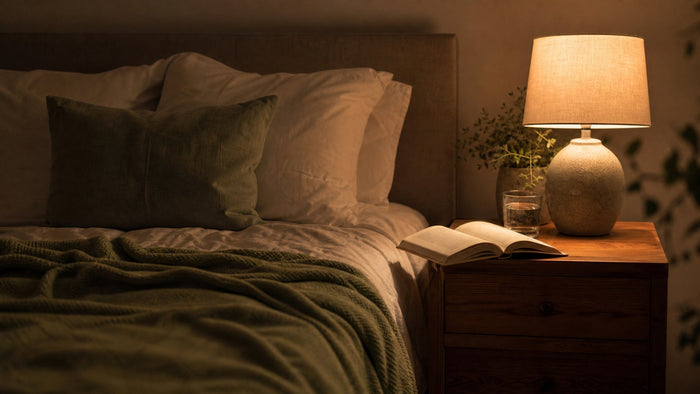
- 60 minutes before bed — phone goes on charge in another room. Bright overhead lights off; lamps only.
- 30 minutes before bed — something low-stimulation. Reading. Stretching. A warm shower. A boring podcast.
- 10 minutes before bed — slow breathing. Inhale for 4 seconds, exhale for 6. The longer exhale is the parasympathetic signal.
- In bed — if your mind starts looping, name it ("the brain is doing its thing again") and return to the breath. Don't argue with the thoughts. Just don't follow them.
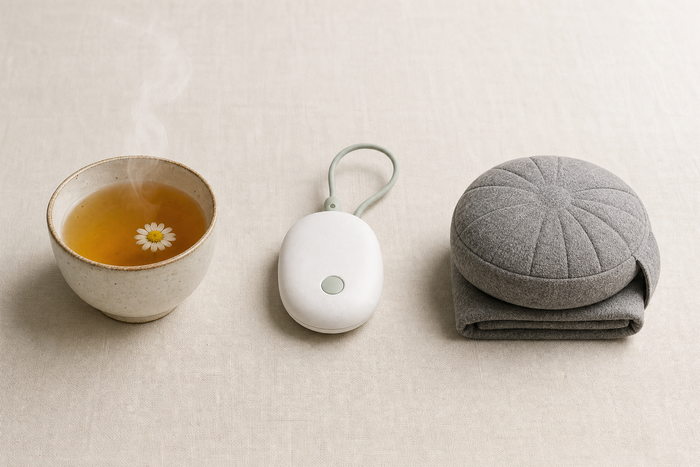
Add a Calmiora session anywhere in that window if you want a little extra signal. Core is the simplest place to start.
Frequently Asked Questions
Why does my mind race more at night than during the day?
During the day, external tasks and stimulation occupy your attention. At night, that drops away, and your brain — particularly the default mode network — has more room to surface unresolved thoughts. Cortisol levels also rise late in the evening for many people experiencing chronic stress, which adds physiological alertness on top.
How long does the parasympathetic shift actually take?
For most healthy adults with a calm environment and no major stress, somewhere between 20 and 45 minutes from the start of wind-down activities. Chronic stress, late caffeine, or bright light exposure can push it well past that.
Is microcurrent stimulation actually scientifically supported?
Microcurrent has been used in consumer wellness contexts for decades, and research on related approaches like CES (cranial electrotherapy stimulation) suggests gentle electrical signaling can influence autonomic balance. Calmiora devices are consumer wellness electronics, not medical devices, and aren't intended to diagnose or treat any condition. They're designed to support a calmer wind-down, not replace medical care.
What's the single most important wind-down habit?
If you only do one thing: get bright overhead light off your eyes 60 minutes before bed. Light is the most powerful signal your circadian system reads. Nothing else compensates for getting this wrong.
Will a wind-down routine help if I have insomnia?
A consistent evening routine helps many people, but persistent insomnia is a medical issue. If your sleep is significantly disrupted for more than a few weeks, talk to a healthcare provider. Calmiora is a wellness companion, not a treatment.
If your mind races in the evening, you don't need to muscle through it. You need the right inputs at the right time. Most of those are free. One or two — like a gentle microcurrent device — are small assists that fit into the rhythm you're already building.
The body knows how to settle. It just needs the right signals.
Disclaimer: Calmiora products are consumer wellness electronics, not medical devices. They are not intended to diagnose, treat, cure, or prevent any disease, and have not been evaluated by the FDA. If you have a heart condition, an implanted medical device, a seizure disorder, or are pregnant, please consult your healthcare provider before use. Individual experiences may vary.